Even the name breathes allure and mystery.
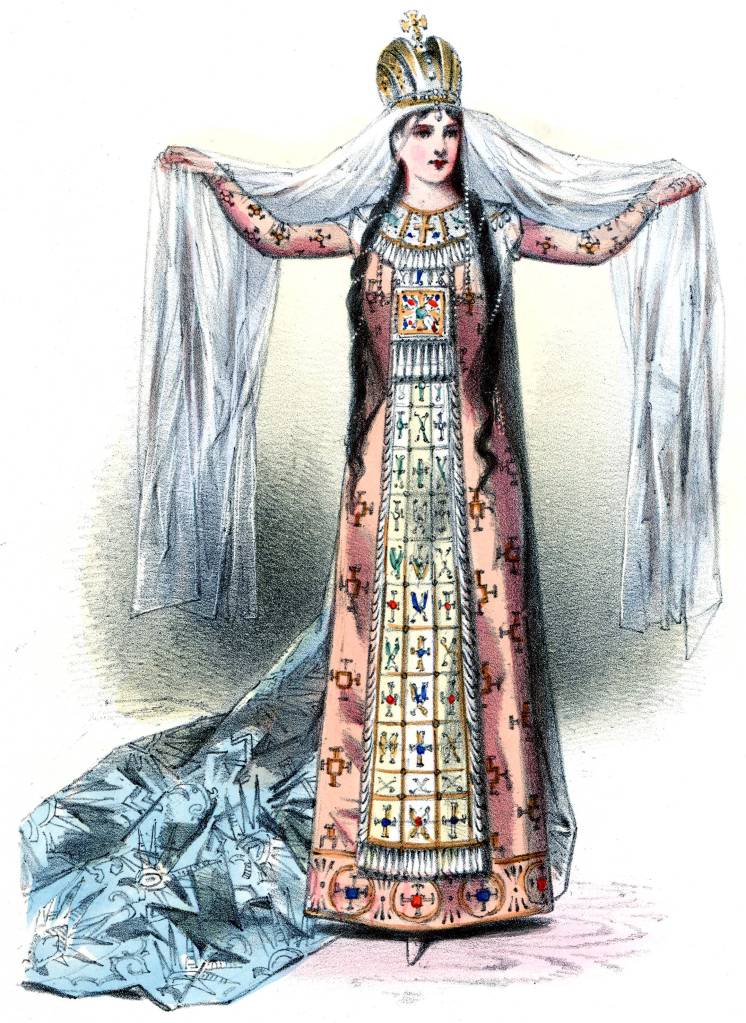
There is a persistent tendency to approach Esclarmonde as one more late-19th-century operatic artifact—an exotic, Wagner-tinted fantasy shaped by spectacle, orchestral richness, and sensual dramaturgy. But this perspective, while not incorrect, remains fundamentally incomplete.
Esclarmonde is not merely a work built upon a libretto. It is, more radically, a work redefined by a voice.
Massenet’s own recollection of his encounter with Sibyl Sanderson—whether partially mythologized or not—reveals something essential: fascination preceded formalization. Yet chronology complicates the narrative. The libretto had already been in his possession for years; composition had already begun.
And still, something shifted.
What Sanderson brought was not simply vocal capacity, but a convergence of intelligence, presence, and technical singularity. The consequences of that encounter are inscribed directly into the score. The extreme high notes that define the role in its final form were not present in earlier stages. They were added. Adjusted. Reworked. The music did not merely anticipate the singer—the music adapted to her.
This is the crucial inversion.
The traditional hierarchy assumes that the singer serves the work. Esclarmonde destabilizes that assumption. Here, the work bends—subtly but decisively—toward the vocal phenomenon that would embody it.
In this sense, Esclarmonde operates less as a fixed composition and more as a responsive system.
This systemic nature extends beyond the voice. The opera itself is an intersection of multiple layers: medieval romance, erotic tension, mysticism, and spectacle. Its source material already contains this duality—le réel dans l’irréel—but Massenet intensifies it through orchestral innovation and structural ambition. The expanded role of the orchestra, the use of leitmotivic thinking, and the heightened sensuality of the harmonic language all contribute to a work that resists simple categorization.
And yet, despite these Wagnerian inflections, the work remains unmistakably French. The vocal line retains its primacy. The melodic contour continues to reflect the inflection of the spoken language. Even at its most symphonically dense, the score never abandons its sensitivity to the human voice.
This is not contradiction. It is synthesis.
What emerges, then, is not a “Wagnerian Massenet,” but a composer who absorbs external influences without surrendering his own identity. The oft-cited criticism—that he had “sold himself to Bayreuth”—fails to recognize the deeper mechanism at play: integration without dissolution.
If anything, Esclarmonde represents the culmination of multiple trajectories already present in Massenet’s output—love and mysticism, sensuality and ritual, the sacred and the theatrical—brought here to their most concentrated and volatile expression.
It is no coincidence that the work was conceived in proximity to the Exposition Universelle of 1889. Like the Eiffel Tower rising at the same historical moment, Esclarmonde is not simply a work of art—it is an event. A demonstration of possibility. A statement of scale.
And yet, precisely because of this, it carries within itself the seeds of its own fragility.
A work so intimately tied to a specific vocal identity becomes difficult to sustain beyond it. Its success depends not only on execution, but on the presence of an exceptional interpretative force capable of reactivating its internal equilibrium. Without that, the system falters.
This is why Esclarmonde has never been a repertory staple in the conventional sense. It is not designed for replication—it is designed for realization.
Ultimately, the opera resists reduction to narrative. Its true engine is not plot, but desire—desire mediated through concealment, power, and revelation. The famous motif of invisibility, the prohibition of sight, the tension between presence and absence—these are not decorative elements. They are structural.
Esclarmonde is not about love in its simplest form.
It is about what happens when desire is structured, intensified, and finally exposed.
And within that structure, the voice remains the central axis.
Not as ornament.
Not as vehicle.
But as origin.
Today, if one is to consider a viable embodiment of this role, it becomes necessary to return to that original premise: the work demands not adequacy, but exception.
In this sense, the only convincing Esclarmonde in our time is Jessica Pratt—whose dramatic intensity, impeccable diction, precise coloratura, and secure extension (including the G6) align not only with the technical demands of the role, but with its underlying structural logic.
Because Esclarmonde does not tolerate approximation.
It requires alignment.
Nothing less.
— Fabián Mecle
 WhereLightRemains